October 2026 Update
October, 2026
Somewhat annoyingly a journalist had the same riff that we did on the new bond crisis gradually enveloping the EUSSR. Since we were "going to press' we couldn't (be bothered to?) change it. Witticisms have many owners.
Our acronym stands for 'French Republic OATs Go Soggy'.
About 15 years ago we had a PIIGS crisis, for which the solution was to kick the can down the road and we now have the French government unable to persuade investors that its debt levels are sustainable, that its interest payments on its debt are adequate compensation for the risk of default and unwilling to or unable to tell its citizens that you can't keep spending as if there was such a thing as a Modern Monetary Theory or Magic Money Tree. The lunatics did have their hands on the controls for a while and managed to do quite a bit of damage to inflation expectations. If something can't go on forever it will stop. It's taken a while for this fiscal unsustainability to reappear, but the required hard yakka is now harder than it was in 2012 or even 2002.
We are not holding our breath for a shift in the central planning and diktats from Brussels. The EUSSR Politburo has a lot to answer for.
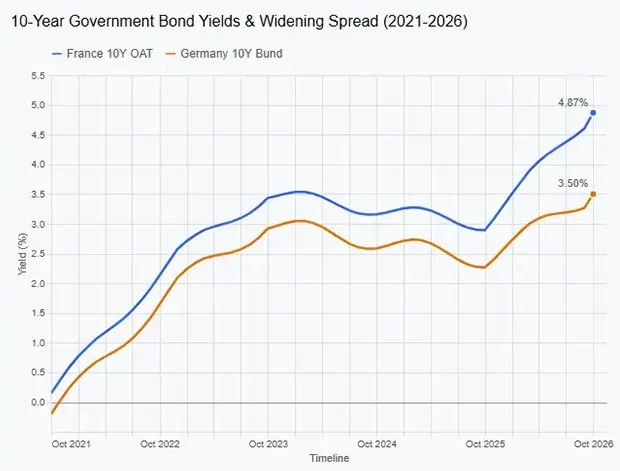
With French yields on Obligation Assimilable du Trésor now approaching 5% and the spread to the Bund widening, it looks like something has to give? If there hadn't been such a drubbing for the CDU in recent German State elections maybe the Germans would have rolled up their sleeves and helped their neighbours, but the popular AfD are focussed on fixing problems closer to home.
https://www.delftpartners.com/news/views/july-2026-bmw-be-more-worried.html
Political solutions and a more responsible/functional government may be the answer but the French,… well the French like to express their discontent with changes in their entitlements 'forcefully'. Contagion is certainly possible. We remain underweight European equities but are channelling our inner Chuck Prince, and thus we're dancing close to the entry. Political will has traditionally triumphed over economic common sense in Europe and the solutions are obvious to us so there may be a shift? That would result in a rapid re-evaluation of European equities.
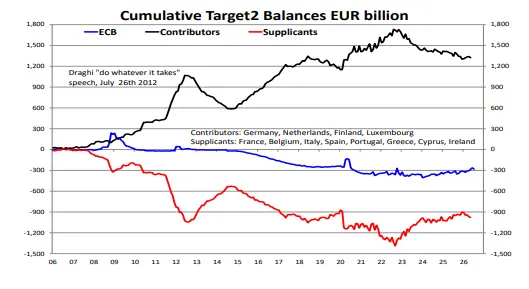
The TARGET2 balances are somewhat arcane but the extent to which nothing has really been changed since Mario Draghi 'saved' the Euro can be seen in the chart below. Kindly with permission from DSG Asia.
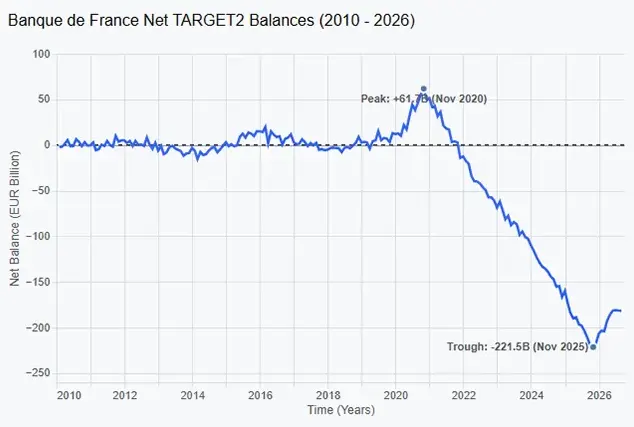
And for La Belle France alone:-
The USA of course has no moral high ground to which to lay claim here, but their approach to grow the economy faster to reduce the burden of debt seems more sensible to us than the European solution of Net Zero, more regulation and taxation. We also expect tariffs in anything but name to be placed soon on Chinese exports to the EU. The challenge for the USA is that growing private capital demands AND continued government demand for capital mean a higher price for the capital unless overseas savings can be mobilised, or government spending reduced, and it certainly means share buy backs should no longer be the norm.
To attract Foreign Direct Investment or to tap into overseas savings, the USA administration may need to be more er, 'consistent' and approachable?
As Simon Ogus of DSG Asia presciently observed there are essentially 5 ways for governments to reduce excessive debts.
Pay back what is owed and tighten the belt - yeah right! The pain to produce supply side reforms, cuts in real wages with the required societal togetherness, and lower returns on the stock markets are rarely accepted. See French streets anywhere this is tried.
Default. President Trump did suggest this is what the USA should do for Chinese held US debt. Hopefully a joke.
Concealed Inflation to reduce the real value of the debt. It has to be concealed otherwise the lenders would demand higher coupons to compensate for loss of purchasing power. Given that we're on red alert now for inflation this will be tough.
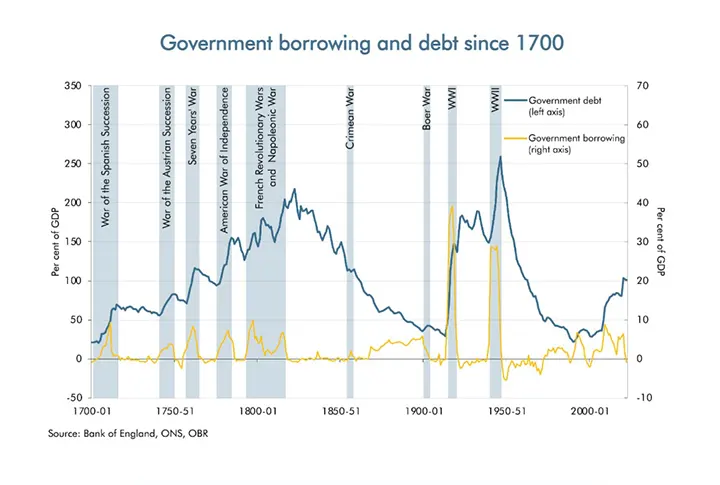
Establish and run a global trading empire and essentially appropriate the assets of other countries in exchange for providing law and order. This was the British solution after the Napoleonic Wars created a monumental debt pile but rather harder to achieve today for a number of reasons?
Financial Repression in which savers are forced (for prudent reasons you understand) to invest in government debt at rates below inflation. To provide some context here, the US banking system in 1947 held c. 1/3rd of their assets in government bonds and having fallen to below 10% by 2008 is still only at 20%. It's been done before and when combined with a little contribution from solution 1, it could work.
Solution 4 illustrated below! (ack DSG Asia)
Where does that leave our equity portfolios? The current end q3 characteristics are posted below. Performance was pleasing in q3 albeit the GHC30 stock portfolio underperformed since we decided to halt the profit taking as our favourite stocks were getting unreasonably sold down. We took the short-term pain which is not unexpected in such a concentrated portfolio. September saw a strong bounce back with outperformance of the Value index of over 2%.
Over that 12 months to end September the returns in A$ are 26.4% for the Value oriented GHC30, 27.0% for the diversified Global Trust and 1.4% for the Global Listed Infrastructure strategy. All have outperformed relevant benchmarks and 'passive' ETF options.
With DODO as the diplomatic strategy of choice at the moment (Deal On Deal Off) market volatility is likely to remain elevated and trading frequency increased and even returns to be more volatile.
Currently we do not have monetary accommodation to ease the oil price increases. This represents a contrast to the 1970s an era in which the USA and the UK expanded money supply aggressively to ease the pain of the rising price of oil. Japan and Germany did no such thing and did not suffer the inflation of the 1970s that so plagued the UK. Meaning if we do not see monetary accommodation then inflation will start to decline BUT there will have to be a shift in consumption preferences meaning fewer dollars, Euros, Yen and Pounds to be spent on consumer goods. We are consequently leery of buying into Consumer Cyclicals and even Staples even if they have underperformed markedly.
We bought some more Murata in Japan after a silly sell-off, initiated a position in Marubeni (we have long liked the Japanese Trading Houses and held Itochu for years), Fortum for its nuclear power exposure and expertise, and added to Union Pacific.
| Global Diversified Portfolio | |
|---|---|
| Market Cap (mm) | 332,387 |
| P/E | 17.4 |
| P/BV | 4.7 |
| P/Sales | 3.9 |
| Dividend Yield | 2.2% |
| ROE % | 21.3% |
| Forward P/E | 17.5 |
| EPS 1 Yr Growth % | 19.5% |
| # of Securities | 95 |
| Active Share | 89.4% |
| Tracking Error | 3.3% |
| Capture Ratio | 66.8% |
| Beta | 0.79 |
| GHC 30 Portfolio | |
|---|---|
| Market Cap (mm) | 319,408 |
| P/E | 19.2 |
| P/BV | 6.9 |
| P/Sales | 4.6 |
| Dividend Yield | 1.7% |
| ROE % | 23.7% |
| Forward P/E | 14.6 |
| EPS 1 Yr Growth % | 16.8% |
| # of Securities | 30.0 |
| Active Share | 98.1% |
| Capture Ratio | 95.3% |
| Beta | 0.9 |
| Infrastructure Portfolio | |
|---|---|
| Market Cap (mm) | 53,660.9 |
| P/E | 16.3 |
| P/BV | 3.6 |
| P/Sales | 2.6 |
| Dividend Yield | 0.0 |
| ROE % | 17.8% |
| Forward P/E | 17.4 |
| EPS 1 Yr Growth % | 12.3% |
| # of Securities | 58 |
| Active Share | 87.1% |
| Beta | 0.95 |
Delft Partners October 2026
DISCLAIMER
This report provides general information only and does not take into account the investment
objectives, financial circumstances or needs of any person. To the maximum extent permitted by law,
Delft Partners Pty Ltd, its directors and employees accept no liability for any loss or damage
incurred as a result of any action taken or not taken on the basis of the information contained in
the report or any omissions or errors within it. It is advisable that you obtain professional
independent financial, legal and taxation advice before making any financial investment decision.
Delft Partners Pty Ltd does not guarantee the repayment of capital, the payment of income, or the
performance of its investments. Delft Partners operates as owner of API Capital Advisory Pty Ltd
AFSL 329133.